
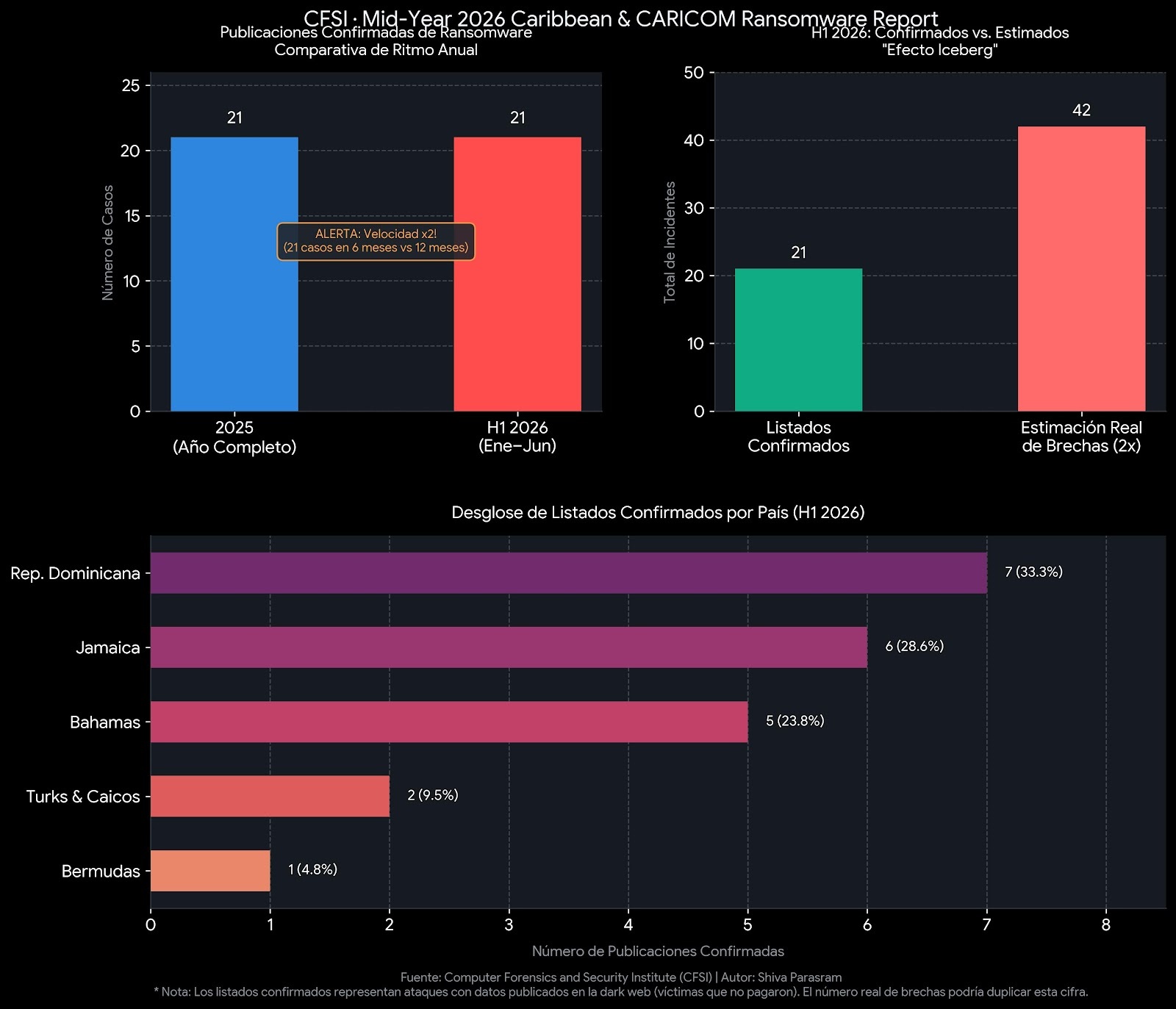
Ransomware is no longer a question of if you will be attacked, but when, and how you find out. In the first half of 2026, the Caribbean recorded 21 confirmed ransomware attack listings on dark web leak sites, the same number as all of 2025, according to the mid-year report from the Computer Forensics and Security Institute (CFSI). Six months did the work of twelve.
Volume Is Only Part of the Problem
In Latin America, Kaspersky reports more than 1.1 million ransomware attempts in 12 months, around 3,000 a day, or 2 attacks per minute. Although the company also noted a drop in attempts versus the prior year, its analysts warn that lower volume does not mean lower risk: attacks are increasingly targeted at high-value victims, which raises the impact of each incident.
In Central America and the Caribbean, Kaspersky's 2025 data shows who bears the brunt: Panama led with 12,665 detected attempts, followed by El Salvador (5,860), the Dominican Republic (3,094), Guatemala (1,331) and Costa Rica (1,144). Together, the five countries account for roughly 24,100 attempts.
For a business, each attempt can mean downed systems, lost access to critical data, delayed customer service and halted operations. The real cost is rarely the ransom itself: it's the downtime.
The Real Vulnerability: Lack of Visibility
Daniela Álvarez de Lugo, General Manager for NOLA at Kaspersky, puts it precisely:
"The priority should no longer be just to react when an incident occurs, but to have visibility, early detection and response capability so that a threat does not become a business interruption."
Most organizations have no continuous monitoring of lateral movement inside their network. The uncomfortable questions: do you know which machines talk to each other, and why? Would you notice an admin account being used at 3 a.m.? How long would it take you to realize someone has been inside for two weeks?
The Solution: Real-Time Detection and Response
The solution is not one more antivirus. Signature-based antivirus recognizes known threats, but modern ransomware changes constantly and abuses legitimate tools. What you need is a real-time detection and response layer that monitors the behavior of files and processes, not just known signatures.
A layer like this lets you:
Detect mass-encryption patterns (a single process modifying thousands of files in seconds) in under 240 milliseconds.
Isolate the compromised device from the network before the attack spreads.
Stop the malicious process and roll back changes where possible.
Keep a forensic trail to investigate how the attacker got in and close that door.
The difference between an incident contained on one machine and a company-wide shutdown is often measured in seconds.
The Threat Group Landscape
The ecosystem is dominated by Ransomware-as-a-Service (RaaS) operations, in which developers license their tools to affiliates who carry out attacks and split the proceeds. This lowers the technical barrier and explains why volume and geographic reach keep growing.
Qilin was the dominant threat in the Caribbean in 2025 with 8 listings, and is the world's #1 ransomware group by volume: it claimed over 1,000 victims in 2025 and, according to Check Point, led Q1 2026 for the third consecutive quarter with 338 victims. Clop (TA505) continued its mass-exploitation campaigns in 2026 with 2 listings in the Caribbean. LockBit is also worth watching: it came back strongly in 2026 with its 5.0 version.
The message is clear: the region is not a minor or marginal target. To RaaS groups, your company is an opportunity like any other.
What Is Your Network's Blind Spot?
Does your organization lack real-time visibility into what's happening on its network? The first step is knowing where the blind spot is.
Book a free 15-minute diagnostic here →
Sources
CFSI, 2026 Mid-Year Caribbean and CARICOM Ransomware Report (PDF)
Kaspersky, 2025 figures for Central America and the Caribbean, via elDinero
Kaspersky, Latin America Threat Landscape, via Forbes Chile
Check Point Research, The State of Ransomware Q1 2026
GuidePoint Security, GRIT 2026 Ransomware & Cyber Threat Report