Digital transformation in the Caribbean, Latin America, and the United States has reached an inflection point. It is no longer about modernizing for modernization's sake: it is about survival. When a Category 5 hurricane shuts down a data center in San Juan, when ransomware encrypts the servers of an offshore bank in Nassau, or when sudden regulation demands data sovereignty in São Paulo, traditional infrastructure — siloed, rigid, dependent on specific hardware — becomes an anchor, not an engine.
At V-Corp International, we have observed a critical convergence: the organizations that thrive in 2026 are not those with the most hardware, but those with the smartest infrastructure. Software-Defined Infrastructure (SDI) represents that evolutionary leap. It is not a technology; it is an operational philosophy that decouples control from hardware, unifies silos, and delivers the agility the region demands.
What is Software-Defined Infrastructure (SDI)?
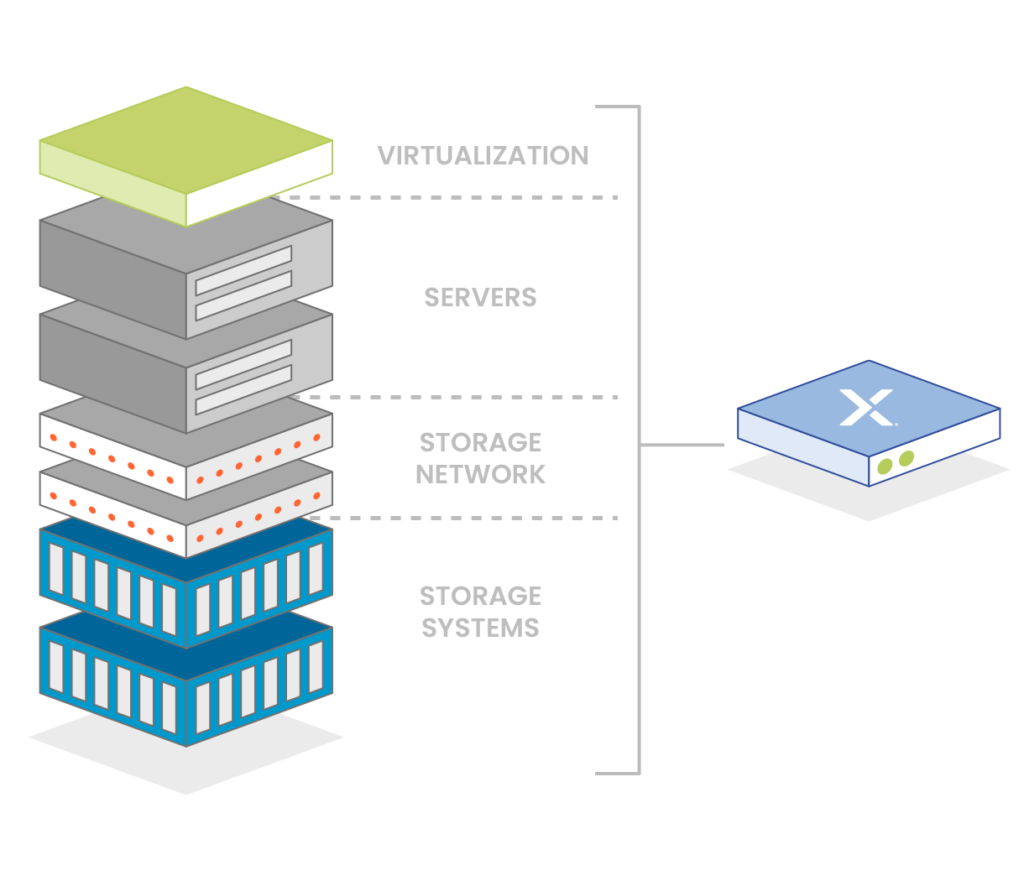
SDI is the logical evolution of virtualization. While traditional virtualization abstracts servers, SDI abstracts the entire data center: compute, storage, networking, and security, governed by intelligent software from a single control layer.
Traditional Layer Regional Problem SDI Layer Solution
Physical servers Provisioning time: weeks Virtualized compute (Nutanix AHV) Minutes, not weeks
SAN/NAS storage High cost, complexity Software-defined storage (Nutanix DSF) Convergence, no dedicated arrays
Hardware-centric networks Manual changes, errors SDN (Juniper Contrail) Programmatic automation
Fragmented monitoring Blind to latent threats Observability (Quantea) Real-time total visibility
Cloud vs. on-prem Binary decisions, lock-in Unified hybrid cloud (HPE GreenLake) Consumption flexibility, sovereignty
The Nutanix Case Study: Government Modernization in Brazil
The Court of Auditors of the state of Mato Grosso, Brazil, faced a familiar regional challenge: a legacy infrastructure based on VMware and Dell that had served for a decade, but now presented rising costs, licensing complexity following VMware's acquisition by Broadcom, and a critical inability to scale toward artificial intelligence workloads.
According to reports from BNamericas, the institution migrated to the Nutanix Cloud Platform, deploying Meta's Llama model directly on its on-premise environment. The result: agility in people management with data kept in its own data center, meeting sovereignty requirements while exploring applications for electronic bidding analysis.
"Only 12% of our customers in Brazil work with VMware. We are serving many new customers seeking greater security and convergence." — Leonel Oliveira, General Director, Nutanix Brazil
At the Acre state Department of Finance, another emblematic case, the migration to Nutanix was specifically motivated by the search for greater security and convergence, in addition to uncertainty generated by changes in VMware's licensing model. There, Llama 3.2 and Gemma 2 models run on Nutanix NIA clusters, integrated with IBM Granite solutions.
Why does this matter for the Caribbean and LATAM? Because it replicates exactly the pattern we see in Puerto Rico, the Dominican Republic, and Jamaica: governments and enterprises with limited budgets, data sovereignty needs, and the urgency to adopt AI without depending on foreign hyperscalers. Nutanix enables an agency with 10 engineers to manage 1,000 virtual machines and 1,000 containers — an operational efficiency unthinkable in traditional architectures.
The V-Corp SDI Architecture: Five Pillars, One Ecosystem
1. Converged Compute: Nutanix Cloud Platform
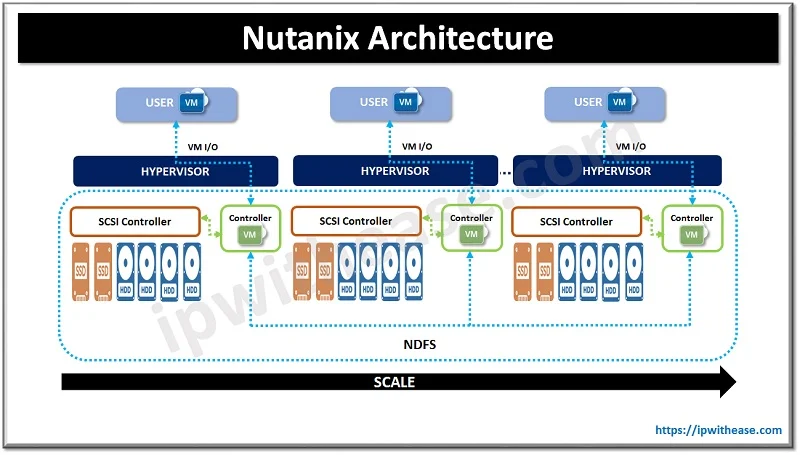
Nutanix is the core of our SDI architecture. Its hyperconverged infrastructure (HCI) platform unifies compute, storage, and virtualization into a single software stack.
Regional advantages:
AHV (Acropolis Hypervisor): Native hypervisor, no VMware licensing costs, present in over 70% of deployments in Brazil.
Nutanix Enterprise AI (NAI): Platform for deploying LLMs on-premise, in the cloud, or at the edge — critical for data sovereignty in offshore banking and government.
Prism Central: Unified management of multiple clusters, ideal for organizations with multi-island or multi-country presence.
2. Trusted Hardware: Dell PowerEdge
Dell Technologies provides the physical foundation on which the software runs. Latest-generation PowerEdge servers are optimized for HCI, AI, and edge workloads.
Key differentiators:
PowerEdge XE9680: GPU-accelerated servers for AI inference and language models.
iDRAC9: Out-of-band remote management, essential when engineers cannot fly to an island after a hurricane.
Nutanix XC Certification: Validated and optimized hardware for the Nutanix platform, eliminating compatibility risks.
3. Flexible Hybrid Cloud: HPE GreenLake
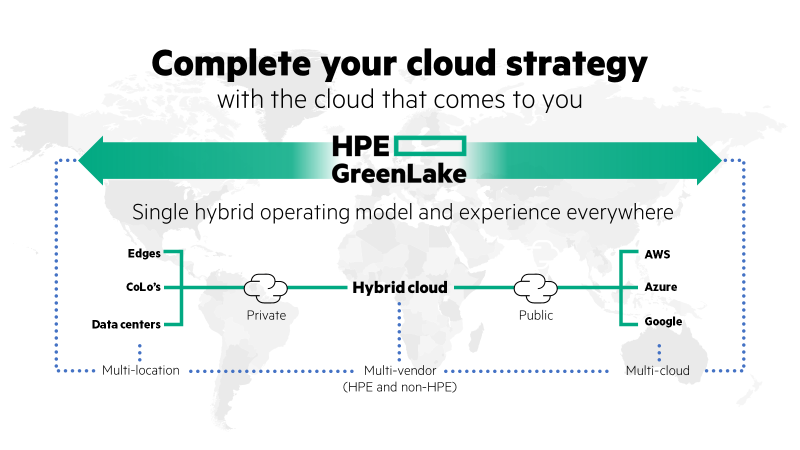
HPE GreenLake resolves the classic "build or buy?" dilemma with a third path: the cloud that comes to you.
Value model for the Caribbean:
Pay-per-use consumption: Ideal for variable government budgets and seasonal tourism enterprises.
Guaranteed sovereignty: Data remains in your facilities or regional data centers, not foreign hyperscalers.
Unified Experience: Same operational interface for on-premise, edge, or public cloud workloads (AWS, Azure, Google Cloud).
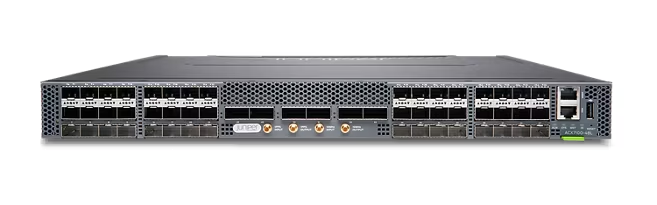
4. Software-Defined Networking: Juniper Networks
Juniper Networks brings the intelligent connectivity layer. In a region where inter-island and cross-border connectivity is fragmented, having a programmatic, automated network is not a luxury — it is survival.
Critical capabilities:
Contrail Networking: SDN that automates virtual network provisioning, microsegmentation, and security policies.
ACX Series: Metro routers optimized for high-performance connectivity between data centers and branches.
Mist AI: Artificial intelligence for network operations (AIOps), predicting failures before they impact services.
5. Advanced Observability: Quantea
Quantea closes the loop with deep network traffic visibility. In an SDI architecture, where physical boundaries vanish, knowing exactly what flows through the network becomes fundamental.
Regional applications:
Real-time traffic analysis: Detection of anomalies indicating ransomware lateral movement.
Regulatory compliance: Forensic evidence for FATCA, GDPR, and local banking regulation audits.
Performance optimization: Identification of bottlenecks in inter-island or cross-border connectivity.
Disaster Resilience: The Caribbean Crucible
The Caribbean presents a unique challenge: infrastructure must survive both digital threats and natural phenomena. Our SDI architecture addresses both vectors:
Risk Scenario V-Corp SDI Response
Hurricane destroys primary data center Asynchronous Nutanix replication to secondary site in HPE GreenLake (outside hurricane zone)
Ransomware encrypts workloads Immutable Nutanix snapshots + Dell EMC PowerProtect backup + minute-level recovery
Primary ISP failure Juniper SD-WAN with automatic failover to cellular/satellite connectivity
Sudden demand (tourist season) Elastic scaling via HPE GreenLake, without upfront hardware purchase
Surprise regulatory audit Quantea delivers complete traffic traceability; Nutanix Prism provides compliance reports
Digital Sovereignty: The 2026 Imperative
Data sovereignty regulations are tightening across the region. Puerto Rico operates under US federal frameworks with strict data residency requirements. Brazil has LGPD. The Dominican Republic and Jamaica are developing their own frameworks.
The SDI architecture we propose at V-Corp International ensures your critical data remains under your control, in your jurisdiction, without dependency on hyperscalers that may change terms or data locations.
"Sovereignty is not just where the data is, but who controls the encryption keys and who can observe, manage, and secure that data without exposure to external entities." — Adapted from Lee Caswell, SVP Product & Solutions, Nutanix
Conclusion: From Survival to Competitive Advantage
Software-Defined Infrastructure is not the future; it is the present that Caribbean, Latin American, and US enterprises need to adopt today. In an environment where digital and climatic hurricanes are the norm, resilience is not built with more hardware: it is built with smarter infrastructure.
At V-Corp International, we do not sell servers. We design ecosystems. We combine Nutanix, Dell, HPE, Juniper, and Quantea into architectures that transform your data center from a cost center to an innovation engine.
Take the Next Step
👉 Evaluate your current infrastructure — Our architects will analyze your SDI posture and deliver a modernization roadmap in 72 hours.
👉 Explore Nutanix solutions for your industry — From government and banking to tourism and manufacturing.
.
The future of your infrastructure is not defined by the hardware you buy. It is defined by the software that controls it.