The growth numbers are remarkable. Inventory across the region's four largest markets (São Paulo, Querétaro, Santiago and Bogotá) grew 41.3% between Q1 2025 and Q1 2026, reaching 1,045 MW, according to CBRE's Global Data Center Trends 2026 report. No other region in the world grew as fast. Yet in Querétaro, the most dynamic hub of all, some projects have been waiting two years just to connect to the power grid.
For a pharmacy chain with twelve locations or a 150-person clinic, this sounds like a fight among hyperscalers. It isn't. Every megawatt the cloud giants compete for ends up on the mid-sized company's bill: in the price of a colocation rack, in the space that's left, and in the milliseconds it takes for the system a cashier or an on-call physician relies on to respond.
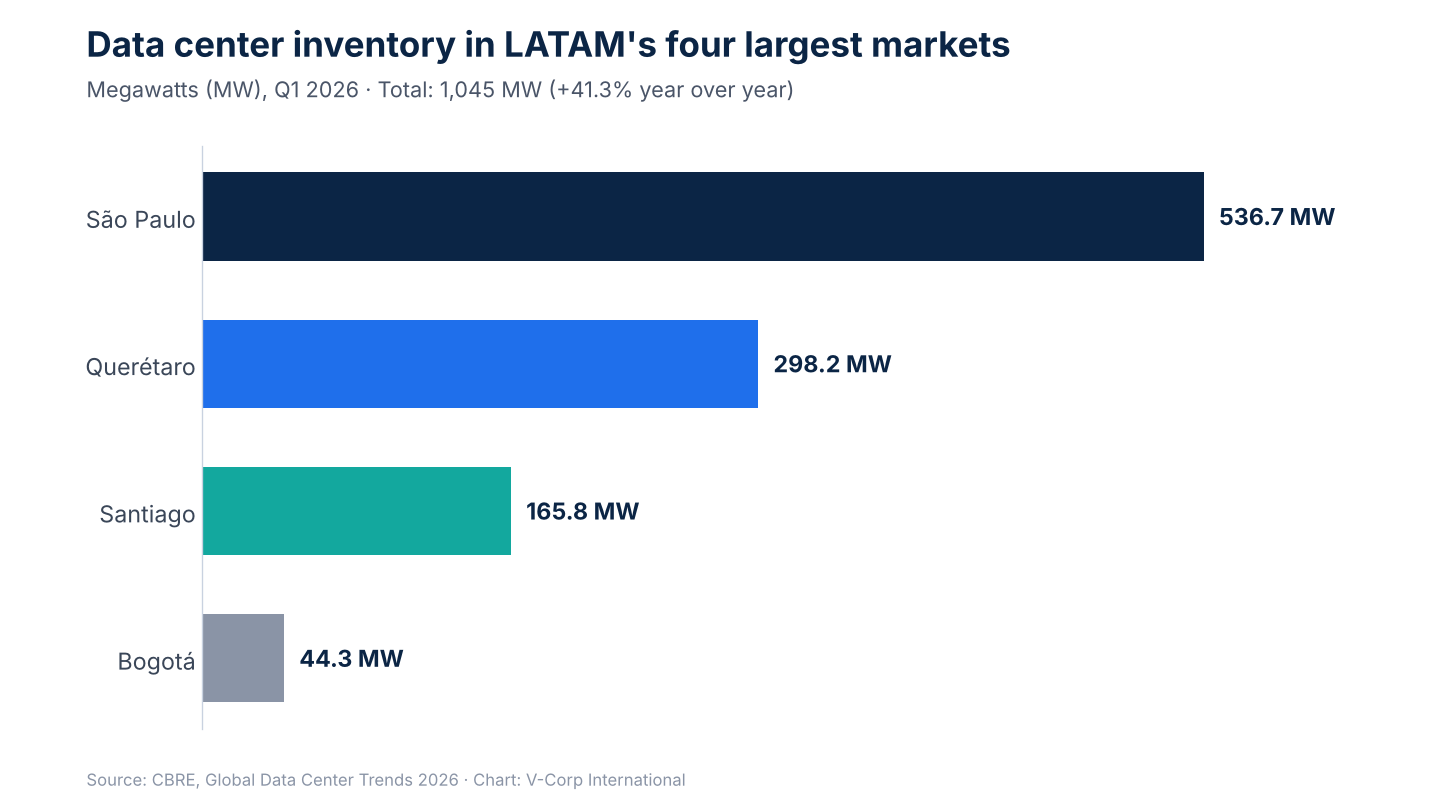 Data center inventory in Latin America's four largest markets, Q1 2026. Source: CBRE.
AI rewrote the industry's power bill
The International Energy Agency (IEA) estimates that data centers consumed around 415 TWh in 2024, roughly 1.5% of the world's electricity. By 2030 it projects about 945 TWh: more than double, and slightly above what all of Japan consumes today. Artificial intelligence is the engine. Accelerated servers, the GPU-equipped machines that train and run models, are growing their power draw by 30% a year; conventional servers, by 9%.
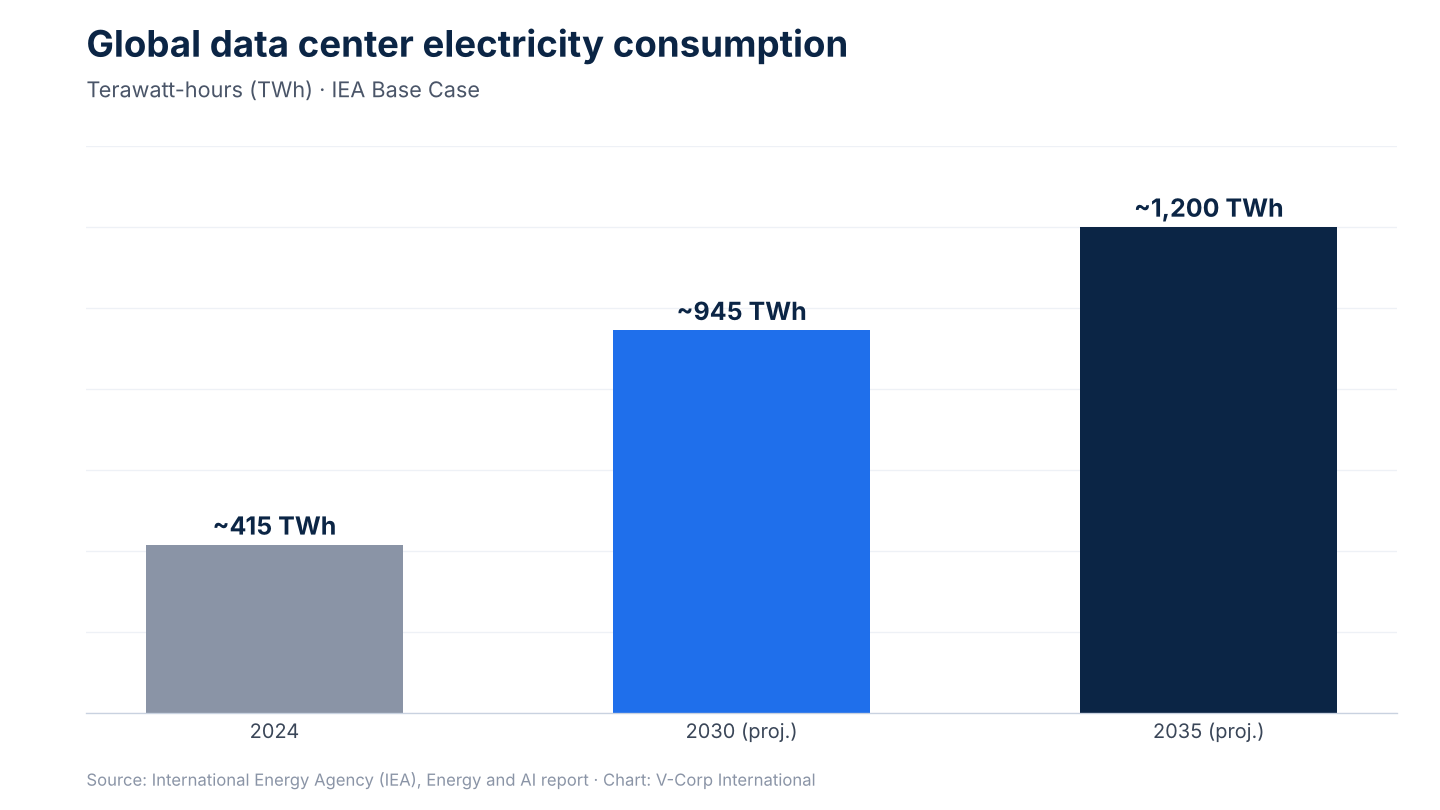 Global data center electricity consumption. Source: IEA, Energy and AI report.
You can feel that jump inside the rack. The Uptime Institute Global Data Center Survey 2026 recorded, for the first time in its history, a modal density above 11 kW per rack. Just two years ago the average was still below 8 kW. A single eight-GPU server can draw as much as an entire cabinet of traditional gear, and that's when the symptoms every IT manager recognizes show up: electrical panels at their limit, UPS units tripping into overload, and a comfort air conditioner doing, badly, the job of a precision cooling system.
The IEA adds a warning that belongs in every expansion plan: unless grids are reinforced, around 20% of the data center projects planned worldwide could face delays.
Infrastructure investment: the race has started, and the big players are winning it
Money isn't the issue. The Mexican Data Center Association (MEXDC) estimates that investment in the sector could reach USD 82.5 billion between 2026 and 2031, and Chile released an official investment guide with more than USD 4 billion in projects moving forward. In 2025, according to JLL's Latin America report, the region delivered a record 184 MW of new colocation capacity.
The fine print tells a different story. Hyperscalers reserve capacity years in advance, and a 200-employee company gets what's left, at whatever price the market sets. Launching a project in Querétaro today takes about 111 permits, not counting the energy side. Nobody at a mid-sized retail chain should be thinking about building their own data center.
What they should be thinking about is which parts of their infrastructure need to stay close and which can travel. The market signal is clear: in 2026, for the first time, third-party facilities (colocation, cloud, hosting and SaaS) host 46% of enterprise IT workloads, versus 44% still running in company-owned data centers. The basement server room, the one with a residential split unit and an eight-year-old UPS, is running out of excuses.
That doesn't mean emptying it. It means investing precisely: double-conversion UPS sized for the actual load, metered PDUs that show which device draws what, racks with proper airflow management, and local NAS backup so a dropped link doesn't stop operations.
Sustainability: from corporate slogan to license to operate
Querétaro is Mexico's sixth most water-stressed state and, at the same time, the heart of the country's data center expansion. That tension already has regulatory consequences: the state government announced that starting in 2027 it will publish the water consumption of data centers operating in its territory. Today's neighborhood pressure is tomorrow's requirement.
For a small or mid-sized business, sustainability translates into something far less abstract: the electricity bill. According to the IEA, cooling accounts for about 7% of consumption in the most efficient hyperscale facilities and more than 30% in less efficient enterprise data centers. Guess which group the typical clinic server room falls into.
The metric worth tracking is PUE (Power Usage Effectiveness), the ratio between a site's total energy and the energy that actually reaches IT equipment. Uptime reports that the global average PUE has barely moved for years, held back by legacy infrastructure. Lowering it in a small room doesn't require liquid cooling, a technology that pays off at densities a 200-person company will rarely reach. It requires discipline: contain hot and cold aisles, close rack gaps with blanking panels, shut down zombie servers, virtualize, and raise the cooling setpoint within the ranges ASHRAE recommends.
Edge computing: when latency costs sales and patients
A loss-prevention camera that ships every frame to a cloud on another continent spots the theft when the thief is already in the parking lot. A point of sale that depends entirely on the internet link stops taking payments at the provider's first outage. That's why Gartner, after analyzing 30 in-store deployments, points to low latency and business continuity as the main drivers of edge computing in retail.
In healthcare the case is even stronger. Vital-sign monitoring, AI-assisted imaging and telemedicine can't tolerate multi-second pauses. Data sovereignty adds another layer: Mexico's new Federal Law on the Protection of Personal Data Held by Private Parties, in force since March 2025, classifies health information as sensitive data, and Brazil's LGPD follows the same logic. Processing at the edge and sending only what's essential to the cloud shrinks exposure in a sector where breaches are expensive: USD 7.42 million on average, according to IBM's Cost of a Data Breach Report 2025, with 279 days to identify and contain them. 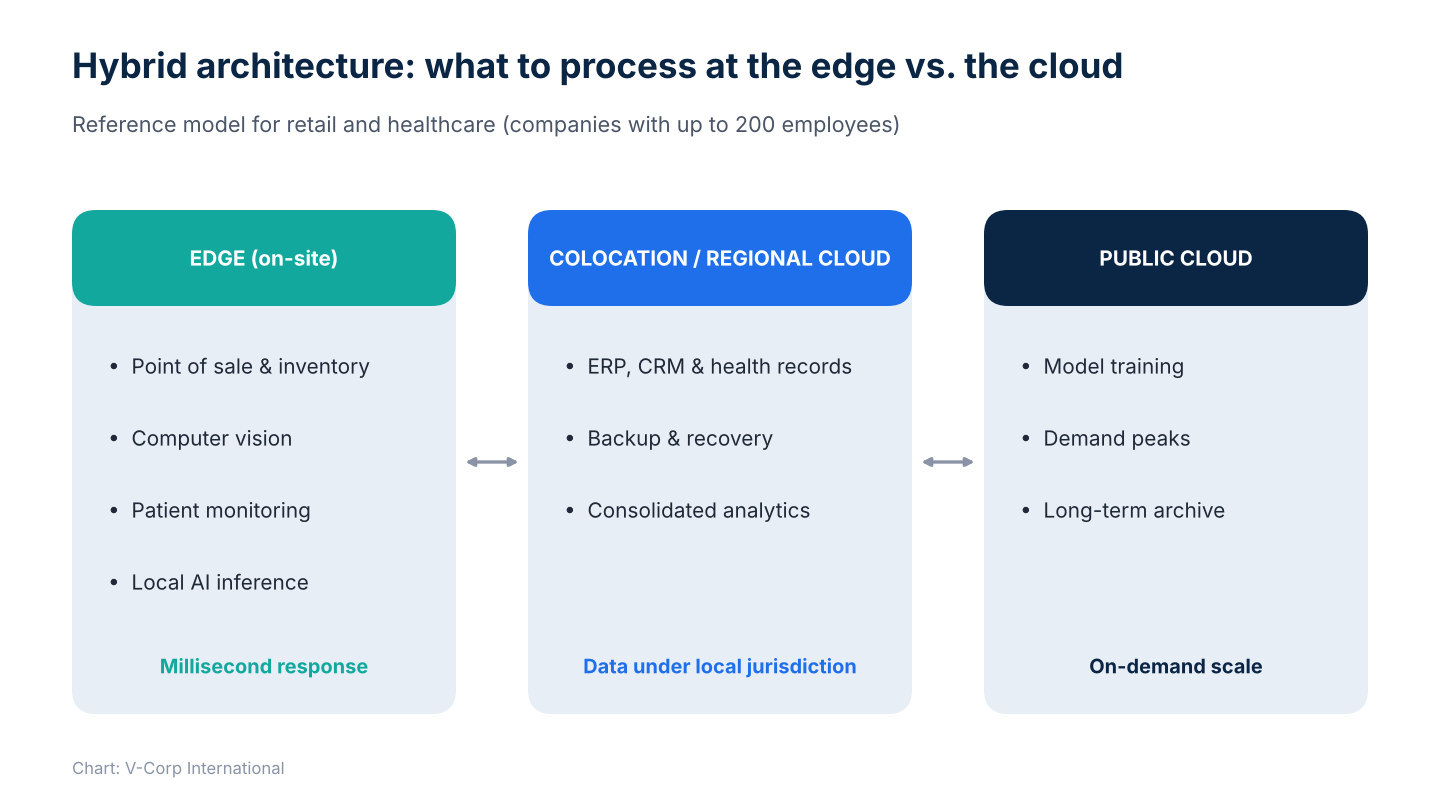 Reference model: what to process at the edge, in colocation and in the public cloud. The edge doesn't replace the cloud. It complements it. The architecture that works best for a company this size has three layers: on-site nodes for anything that needs an immediate response (point of sale, video analytics, AI inference), colocation or a regional cloud for core systems and backups, and public cloud for training models, absorbing peaks and archiving. Every edge node, though, is a new door into the network. It needs its own firewall, segmentation and managed switches.
How we would split the infrastructure budget in 2027
If we ran IT for a retail chain or a medical group with up to 200 employees, this is where we'd put the money.
Power and backup before compute. Buying a GPU server without reviewing the UPS and power distribution is buying a problem.
Then inference at the edge and training in the cloud. Almost no mid-sized company needs to train its own models on-site; what it does need is to run them close to the customer or the patient, with perimeter security to match.
Next, move critical systems that don't need ultra-low latency to an in-country colocation facility, to stay compliant with data regulations and stop depending on a single utility feed.
And measure. PUE, power per rack, application response times. What you don't measure, you pay for twice.
The region will get its megawatts. The capital is committed and the substations will arrive, late, but they'll arrive. The advantage won't go to whoever piles up the most infrastructure, but to whoever puts each workload in the right place before electricity becomes the most expensive input in their operation.
Is your infrastructure ready for the AI era?
At the V-Corp International online store you'll find APC and Eaton UPS systems and PDUs, racks, Synology NAS storage, Fortinet and Barracuda firewalls, and Ubiquiti and TP-Link networking gear to build an efficient, secure hybrid architecture that's ready for edge computing.